Showing posts with label genre: realistic fiction. Show all posts

Sunday, November 21, 2010

The Perks of Being a Wallflower by Stephen Chbosky

Chbosky, Stephen. The Perks of Being a Wallflower. MTV Books/Pocket Books, 1999. 213 pages. ISBN-10: 0671027344. ISBN-13: 978-0671027346.

Plot:
15-year-old Charlie is afraid to start his freshman year of high school. His best friend has committed suicide, his brother is away at college, and he and his sister are no longer as close as they once were. On top of this, Charlie has emotional problems that make it difficult for him to relate to people. To cope with everything, he begins to write letters to an anonymous recipient that he heard was a good listener. Charlie’s letters detail his experience with his family, friends, and the new people he meets. He writes about his Advanced English teacher, who gives him extra reading and encourages him to share his ideas. He reveals information about his family’s past and how it affects who they are now. He writes about learning to “participate” in life and his difficulties with doing so. Perhaps the biggest focus of his letters is his new friendship with two seniors, Patrick and Sam. He loves them both and they are an important part of helping him deal with his life, as well as figure out where he fits in. Charlie changes a lot throughout the course of his letters, but he is faithful in relating every experience along the way.

Critical Evaluation:
The most interesting aspect of this book is the format in which it was written. By choosing to write it as a series of letters to an anonymous recipient, Chbosky personalizes the story in a way that traditional narrative or even journal style could not. It allows readers to truly feel as if Charlie is speaking directly to them. Chbosky also chooses to eschew proper grammar and sentence structure in many instances, but it’s obvious that this is a stylistic choice meant to convey a more authentic teenage voice rather than simply a mistake or poor writing.

There is a sinister undercurrent to this book, which really shows Charlie struggling with emotional issues due to the death of his aunt and (as we later find out) her sexual abuse of him. Charlie seems much younger than his actual age. He’s shy and unconventional, but also socially and emotionally delayed in many ways. Though the content is more appropriate for older teens, Charlie is a character to which younger teens could probably more easily relate. Despite being written almost more than a decade ago, most of the characters could easily have been created today. The parties, friendships, relationships, and other experiences Charlie has ring true.

The Perks of Being a Wallflower has been considered a modern young adult classic since its publication in 1999. It’s the epitome of a coming-of-age novel. Just as my generation loved it when it was published, current and future generations will enjoy and relate to it, as well.

Reader's Annotation:
15-year-old Charlie relates the ups and downs of his freshman year of high through letters written to an unknown recipient.

Author Information:
Stephen Chbosky was born January 25, 1970 in Pittsburgh, Pennsylvania. He attended public school in St. Clair, Pennsylvania at a high school that is a three times nominated Blue Ribbon school. He then attended the University of Southern California as part of their screen writing program. He has worked as a screen writer on a handful of films including Rent, the television series Jericho, and his first film The Four Corners of Nowhere, in which he also acted and directed.

Though he has written several screenplays and edited a collection of short stories, The Perks of Being a Wallflower is his only novel. It is semi-autobiographical and also deeply influenced by Salinger’s The Catcher in the Rye. His writing is also influenced by the works of Tennessee Williams, F. Scott Fitzgerald, and Stewart Stern, the screen writer for Rebel Without A Cause.

Genre:
Realistic Fiction

Curriculum Ties:
English: Writing Style, Journaling

Booktalking Ideas:
  • Discuss who you think Charlie is writing to and if it really matters.
  • Discuss whether their situation determines the person or the person determines their situation.
  • Introduce Charlie and the book plot in letter form.

Reading Level/Interest Age:
15 and older

Challenge Issues:
Depiction of homosexuality
Profanity
Sexual content
Drug, alcohol and tobacco Use
Suicide
Molestation
Rape

Challenge Defense Ideas:
  • Require the challenger to fill out a written challenge form with clear reasons stated and examples given.
  • If not already familiar with the content, become familiar.
  • Refer the challenger to the library's collection policy.
  • Refer the challenger to reputable reviews of the books, as well as reviews by those in the book's target audience.

Reasons for Selection:
This is one of the more well-known YA books of modern times. It is also being adapted for a film in 2011.

Sunday, November 7, 2010

The Catcher in the Rye by J.D. Salinger

Salinger, J.D. The Catcher in the Rye. Little, Brown and Company, 1951. 277 pages. ISBN-10: 0241001870. ISBN-13: 978-0241001875.

Plot:
Holden Caulfield recounts his experiences during a December weekend the previous year. Due to his failing grades, he has been kicked out of yet another boarding school. Instead of waiting for the semester to end, he decides to spend the weekend in New York hiding from his parents. He takes a train in the middle of the night and ends up at a dodgy hotel. After arriving, he spends his time drinking and dancing with tourists in a bar. He is lonely and hires a prostitute, but after seeing her he decides he only wants to talk. She finds him weird and leaves, but Holden pays her anyway. Later she returns with her pimp, demanding more money. They beat up Holden and take the money, so Holden decides to leave the hotel. He spends the next few days wondering around the city, visiting with old friends and attempting to meet up with his younger sister, Pheobe. Eventually he decides to sneak into her room to talk to her, but leaves before his parents can discover him. He then visits an old teacher, but after deciding that the teacher is coming on to him, Holden runs yet again. He decides he will leave for good and head out west alone, but Pheobe has other plans.

Critical Evaluation:
The Catcher in the Rye is a classic for a reason. Despite being written more than fifty years ago, the dead-on teenage voice and attitude is something to which readers of any time period have been able to relate. Salinger captures teenage apathy and idealism perfectly. The stream of consciousness writing and stylistic choices he makes result in a narrative that feels as if the reader is sitting with Holden and listening to him tell his story. Though it might seem as if writing it in that way is a result of laziness, The Catcher in the Rye is expertly crafted.

Everything and nothing happens in this novel. Holden spends three days wandering New York where many of his experiences aren’t incredibly out of the ordinary. It’s his commentary and restlessness while engaging in the activities, along with the extreme importance he attaches to even the most mundane of occurrences, that make it feel as if there is more involved in the weekend than what really happens. This weightiness is unsurprising given that Holden is narrating the experience from a year later, after being hospitalized immediately after that weekend. It also falls in line with the adolescent feeling that every experience and every thought is of the utmost importance. Because of the voice of this character, it is appropriate that this is considered one of the first young adult novels ever.

Reader's Annotation:
After failing out of yet another prep school, Holden Caulfield decides to spend the weekend hiding in New York to avoid being around when his parents find out. He spends his time drinking, looking up old friends, and expounding on his theories on life.

Author Information:
J.D Salinger was born January 1, 1919 and died at the age of 91 on January 27, 2010. He was raised in Manhattan and attended both public and private schools before transferring to Valley Forge Military Academy, where he first started writing short stories. He then attended New York University to study Special Education, but soon dropped out. After a stint working in meat-packing in Austria and attending two more colleges, Salinger began submitting his short stories for publication. In 1942, he was drafted into the Army and was present at Utah Beach on D-Day.

After the war, Salinger returned to his writing. The Catcher in the Rye was published in 1951. The novel was both lauded and vilified, but by the late 50s it was wildly popular, especially among teenagers. The success of the novel and the attention it earned him was overwhelming to Salinger. He withdrew from the public and his writing suffered as he began to publish fewer and fewer stories. Later in life he was involved in several lawsuits involving biographers and copyright violators, including an author who wrote a novel about Holden Caulfield as an adult.

Genre:
Realistic Fiction

Curriculum Ties:
English: Writing Style

Booktalking Ideas:
  • Discuss what Holden means when he calls so many people "phonies"
  • Read the first paragraph and then introduce Holden in character
  • Talk about how this has simultaneously been the most challenged and most taught book

Reading Level/Interest Age:
14 and older

Challenge Issues:
Unsuitable role model
Profanity
Sexual content
Blasphemy
Undermining of family values
Encouragement of rebellion
Alcohol and tobacco use
Association with high profile murders

Challenge Defense Ideas:
  • Require the challenger to fill out a written challenge form with clear reasons stated and examples given.
  • If not already familiar with the content, become familiar.
  • Refer the challenger to the library's collection policy.
  • Refer the challenger to reputable reviews of the books, as well as reviews by those in the book's target audience.

Reasons for Selection:
It has been credited with helping create the category of young adult literature. It still remains one of the most popular YA novels.

Monday, November 1, 2010

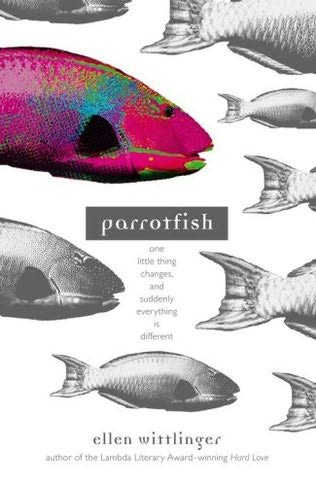
Parrotfish by Ellen Wittlinger

Wittlinger, Ellen. Parrotfish. Simon and Schuster, 2007. 304 pages. ISBN-10: 1416916229. ISBN-13: 978-1416916222.

Plot:
Angela has never really felt like a girl. At the age of 16, she decides instead to start living as a boy. She cuts her hair short, binds her breasts, starts dressing in boys clothes, and asks that everyone refer to her as Grady from now on. Grady’s family has a hard time accepting this, especially his mother and sister. His best friend, Eve, even drops him as a friend, deeply hurting Grady in the process. Acceptance isn’t quick to come in school either. Many of the teachers and the principal refuse to acknowledge his new identity and some of the students start to bully him. Eve’s new friends make Grady the target of some very cruel jokes. Even those who are more accepting of his change don’t fully understand how hurtful their ignorant and supposedly innocent comments and actions are, such as when two members of the basketball team decide to dress up as girls for a laugh. As Grady struggles with acceptance, he questions why it is so important what gender a person is.

Luckily, Grady has the help of his new friend Sebastian and the female gym coach. Both accept Grady for who he is without any reservation and do whatever they can to help him. He also falls in love for the first time with a beautiful and kind girl named Kita. With the support of his new friends, he gains the courage to deal with those who are against his transformation. In becoming who he really is, he also helps those around him begin to find out who they really are.

Critical Evaluation:
With Parrotfish, Wittlinger has made an important contribution not only to GLBT literature, but young adult literature in general. In young adult literature, there is a lack of books focusing on transgendered teens. Those that do often present it in either a joking manner or involve tragedy. Parrotfish does neither. There is humor and there are hardships, but it’s a serious and uplifting story over all. It’s not a story that is strictly about a transgendered character dealing with the change, however. It’s also about a teenager’s first love and friendship and dealing with family difficulties. These are all things to which any teenager can relate, not just those who are questioning their gender or their identity. By rounding out the story this way, Grady isn’t just a flat symbol to further a message, but an interesting and full person.

Wittlinger’s simple writing style and honest voice are a great vehicle for Grady’s story. The book moves along quickly, keeping the reader engaged. The first-person perspective personalizes the story, so that the reader becomes a part of it instead of looking in from the outside. The use of the imaginary dialogue was a humorous touch and really gives insight into Grady’s character. This book is a great read for those who are questioning their identity or want more insight into people who do. It’s also a great read for anyone looking for a good story to enjoy.

Reader's Annotation:
Transgendered high school junior Angela decides to start living as a boy named Grady. His transformation isn't easy, but he learns who he is and who his true friends and family are.

Author Information:
Ellen Wittlinger was born in Belleville, Illinois on October 21, 1948. As a child, her parents owned a grocery store that was joined to their house and she would often raid the ice-cream and candy shelves. She attended college at Millikin University and then moved to Ashland, Oregon. She stayed there until being accepted to the Iowa Writer's Workshop at the University of Iowa with the intention of becoming a poet. After that, she moved to Provincetown, Massachusetts for a fellowship at the Fine Arts Work Center.

She published a book of poetry and several plays. She first became interested in young adult literature after working as a children’s librarian and having children of her own. She published her first novel in 1993 and has written 12 more novels for young adults, with the last one published in 2008.

Genre:
Realistic Fiction: Gender Identity

Curriculum Ties:
Psychology: Gender Dysphoria
Sociology: Family Dynamic

Booktalking Ideas:
  • Discuss why Grady's family and friends have such a hard time with his change
  • Talk about figuring out who you really are, even if it means being different than everyone else
  • Discuss what it means to be transgendered.

Reading Level/Interest Age:
14 and older

Challenge Issues:
Transgendered protagonist

Challenge Defense Ideas:
  • Require the challenger to fill out a written challenge form with clear reasons stated and examples given.
  • If not already familiar with the content, become familiar.
  • Refer the challenger to the library's collection policy.
  • Refer the challenger to reputable reviews of the books, as well as reviews by those in the book's target audience.

Reasons for Selection:
This is a wonderful book for teens questioning their gender or anyone who would life to better understand those who do.

Sunday, October 31, 2010

Wintergirls by Laurie Halse Anderson

Anderson, Laurie Halse. Wintergirls. Viking Juvenile, 2009. 288 pages. ISBN-10: 067001110X. ISBN-13: 978-0670011100.

Plot:
Lia and Cassie had been best friends since childhood. They shared everything, including a pact to be the skinniest girls in school. After a Lia spends time in the hospital for her eating disorder, Cassie decides to drop her for being a bad influence. They hadn’t talked in months the night that Cassie called Lia 33 times and then died alone in a hotel.

Cassie has been living with her father and claiming to have her disorder under control, but she is a pro at hiding it. The only person who seems able to get through to her is her step-sister, but even she can’t save Lia from herself. Lia is haunted by her guilt about what happened and begins seeing Cassie’s ghost everywhere. Cassie wants Lia to join her, to waste away to nothing until they can be together forever. As she loses more and more weight and her sanity begins to slip, Lia wonders if maybe she should join Cassie after all.

Critical Evaluation:
Laurie Halse Anderson manages to depict the physical and emotional decline associated with a severe eating disorder in a chillingly realistic way. Though Lia is lying to those around her, and even to herself, the reader is spared nothing in the description of her downward spiral. This is a difficult book to read for the same reason that it is an admirable one - it’s honest.

Lia is an unreliable narrator, but in a way that works for the story. It’s difficult to tell when she is being honest or when she is evading the truth. It’s also sometimes difficult to determine which events are actually occurring and which are part of her mental breakdown. This coupled with the sometimes unusual and increasingly erratic writing style that is employed only enhances the portrayal of a girl quickly slipping out of control.

The plot could potentially trigger a reader who is suffering from the same disorders; however, it could also help readers feel less alone in their problems or encourage them to seek help before they reach the same state that Lia is in.

Reader's Annotation:
After her best friend Cassie’s sudden death, 18-year-old Lia spirals downward as she struggles to deal with Cassie’s death and her own problems with anorexia.

Author Information:
Laurie Halse Anderson was born October 23, 1961 in Potsdam, New York. She began writing in second grade and has loved it ever since. She attended Georgetown University and received a B.S. in linguistics. After graduating, she worked as a freelance reporter for several years, while working on her fiction writing. In 1998 she became a full-time writer of fiction. She has published 9 books for young adults and 20 books for children.

Though writing was one of her first loves, she also enjoys running, gardening, travel, knitting, and quilting. She lives in Northern New York with her husband and children. Noticing that she was suffering from several distractions, her husband built her a cottage in the woods to be hers to use for her writing. She views this as her answer to the claim of Virginia Woolf that every woman needs a room of her own to write fiction.

Genre:
Realistic Fiction: Eating Disorder

Curriculum Ties:
Health: Healthy Eating
Psychology: Eating Disorders, Depression, Cutting, Grief
English: Character Development

Booktalking Ideas:
  • Read the passage starting "Dead girl walking" placed on page 19 of the e-book version.
  • Discuss Lia and Cassie's friendship.
  • Focus on Lia's relationship with her family.

Reading Level/Interest Age:
14 and older

Challenge Issues:
Anorexia
Cutting
Could be a trigger

Challenge Defense Ideas:
  • Require the challenger to fill out a written challenge form with clear reasons stated and examples given.
  • If not already familiar with the content, become familiar.
  • Refer the challenger to the library's collection policy.
  • Refer the challenger to reputable reviews of the books, as well as reviews by those in the book's target audience.

Reasons for Selection:
This book was recommended to me by my sister. Extreme dieting and disordered eating is something that affects many teenagers including my group of friends when I was in school.

Sunday, October 24, 2010

Some Girls Are by Courtney Summers

Summers, Courtney. Some Girls Are. St. Martin's Griffin, 2010. 256 pages. ISBN-10: 0312573804. ISBN-13: 978-0312573805.

Plot:
Regina used to be a member of the most powerful and feared group of girls in the school. When her best friend’s boyfriend attacks her at a party, Regina chooses to trust the wrong girl and wakes up the next day an outcast. The rumor is that she willingly slept with him and betrayed her best friend. Nothing Regina says can change the story and she’s left with no friends, no boyfriend, and the horrible truth. Having spent years being terrorized by Regina and her former friends, the school is all too happy to turn on her. In an attempt to protect herself from the bullying, she turns to a victim of hers, Michael. Michael is a loner who spends most of his time writing in his journal. He isn’t thrilled to be her savior or her redemption, but he at least chooses not to engage in tormenting her with the rest of the school.

Regina and Michael grow closer as they begin to see each other as individuals instead of a representations of the high school social strata. Despite his initial reluctance to befriend her, they fall for each other. When Regina finds a way to get back at the other girls, they decide to use Michael against her by stealing his journal. As her situation becomes more and more hellish, Regina must choose between her feelings for Michael and saving him from their retribution.

Critical Evaluation:
The bullying in Some Girls Are is brutal and cruel. The acts the characters commit are horrible, but they are never unbelievable. This is a very striking read of exactly what people are capable of doing to each other. Though there are many novels written on the subject of bullying, what makes this book stand out is that there is no black and white to the situation or characters. Throughout Regina’s victimization we’re reminded that not too long ago she was the bully herself. She does feel remorse and often acknowledges that she is probably getting what she deserves, but she doesn’t completely change her ways. She is still willing to lash out and victimize her tormentors when the opportunity presents itself. However, despite the popular mean girl turned outcast storyline, reading this as strictly a story about comeuppance doesn’t do it justice. It’s much deeper than that.

One of the most interesting aspects of the book is the relationship between Michael and Regina. At first Regina uses him as a shield from the rest of the school. In him, she sees both someone to save her and a way to redeem herself for her former actions against. She doesn’t see him as a person, but rather something she can use and her pursuit of him borders on pathetic. To Michael, Regina is simply the mean and spoiled girl who got what she deserved. Summers’s talent is evident in writing the progression of their relationship from that initial point to when they finally fall for each other. Though fast paced, it isn’t rushed or forced. It also doesn’t seem unrealistically sweet or too like a fairy tale. We genuinely believe that two people who originally hated each other are finally starting to see each other as people, even if they don’t really want to. This makes the culmination of the ending drama much more poignant. Some Girls Are is a book that left me feeling sick and sad, but one that I wouldn’t hesitate to read again.

Reader's Annotation:
When Regina’s best friends turn on her, she goes from being one of the most popular girls in school to the most hated.

Author Information:
Courtney Summers was born in Ontario, Canada on April 25, 1986. While in high school, she decided that she wasn’t happy with her education. With her parent’s permission, she dropped out to pursue learning on her own terms. She has many interests and jumps into each with a passion bordering on obsession at times. She has written about her love of both zombies and volcanoes on her blog. She decided to take up both photography and writing during the years she normally would have been in high school and college.

Her first book was published in 2008, her second in 2010, and another will be published in December of this year. She writes exclusively for young adults. She states that her reasoning for doing so is her love of the “immediacy” of young adult fiction, something that isn’t as present in other types of fiction.

Genre:
Realistic Fiction: Bullying

Curriculum Ties:
Psychology: Bullying

Booktalking Ideas:
  • Focus on the scene when Regina first realizes everyone has turned on her.
  • Discuss going from the bully to the bullied.
  • Discuss the relationship between the main character and her "friends."
  • Discuss the relationship between Regina and Michael.

Reading Level/Interest Age:
14 and older

Challenge Issues:
Attempted rape
Profanity
Bullying
Drug and alcohol use

Challenge Defense Ideas:
  • Require the challenger to fill out a written challenge form with clear reasons stated and examples given.
  • If not already familiar with the content, become familiar.
  • Refer the challenger to the library's collection policy.
  • Refer the challenger to reputable reviews of the books, as well as reviews by those in the book's target audience.

Reasons for Selection:
Bullying is big problem with teenagers. This book gives an accurate portrayal of what bullying can be like.

Dreamland by Sarah Dessen

Dessen, Sarah. Dreamland. Penguin, 2000. 256 pages. ISBN-10: 0670891223. ISBN-13: 978-0670891221.

Plot:
Caitlin has always been second to her older sister Cass, but that never stopped Caitlin from loving her. When Cass runs away, on Caitlin’s birthday, her family is turned upside down, especially Caitlin. In order to make things seem a little more normal, Caitlin decides to join the cheerleading squad and take a photography class with her mother and neighbor, both of which turn her mother’s attention a little more towards her. Something is still missing, however, and Caitlin thinks she’s found it in Rogerson, a dark and mysterious drug dealer who becomes her first serious boyfriend. At first, everything is great. She and Rogerson have fun together, he introduces her to a new set of friends, and she loves being with him. Then the beatings start. Caitlin stays with him, trying desperately to do anything to avoid being hit and to hide the bruises when she is. She withdraws more and more from her family and friends and school as she becomes more wrapped up with the relationship and her fear. She begins using drugs and sex and her love for Rogerson to escape from the physical and emotional pain his anger and abuse is causing. Everything escalates until the day Rogerson decides that she does something unforgivable and he reaches a level of anger and violence he never has before.

Critical Evaluation:
Those who have never been in an abusive relationship often wonder how a person can stay in one. Dessen does a fantastic job of showing the reader just exactly how a smart, normal girl can end up in a situation she feels she can’t escape. She shows us Caitlin’s emotional state and the progression of their relationship in such a way that we can feel the same shock and disbelief that Caitlin feels when Rogerson turns abusive. Her love for him and her fear of him are both vivid in their presentation. Though the reader may not fully understand why Caitlin doesn’t seek help – and most certainly wishes for her to do so – the escalating situation is such a believable one that it’s easier to understand how so many people end up in relationships such as these. The ending does seem a little too neatly tied and somewhat unrealistic, but perhaps that is exactly the type of ending that can give the reader hope.

Reader's Annotation:
Caitlin has spent her life living in the shadow of her perfect older sister, Cass. When Cass runs away, Caitlin finally has a chance to find herself, but she's looking in all the wrong places.

Author Information:
Sarah Dessen was born June 6, 1970 in Evanston, Illinois, but spent most of her life in Chapel Hill, North Carolina. Her parents were both professors and she credits her love of reading as being a result of their influence. She studied creative writing and English at the University of North Carolina, where her parents taught. Three years after graduation, she published her first book. A year after that, she was offered a position as a teacher. She took the job, but continued to write.

She has published 9 books for young adults and has another due to be published in May of 2011. She hadn’t intended on becoming a young adult author, but her agent felt she had a strong teenage voice. Much of her inspiration for writing comes from the close group of friends she had in high school as well as continuing to live in her home town, which she says makes it hard to leave high school behind. Her books have won numerous awards.

Genre:
Realistic Fiction: Abuse

Curriculum Ties:
Psychology: Healthy Relationships, Family Dynamic
Health: Drug Abuse

Booktalking Ideas:
  • Discuss Caitlin’s use of photography as a way to hide.
  • Speak as if it were a letter from Caitlin to Cass about the effect Cass‘s leaving had on her.
  • Discuss the downward spiral of Caitlin and Rogerson’s relationship.

Reading Level/Interest Age:
Age 14 and older

Challenge Issues:
Abusive relationship
Drug use
Sexual content

Challenge Defense Ideas:
  • Require the challenger to fill out a written challenge form with clear reasons stated and examples given.
  • If not already familiar with the content, become familiar.
  • Refer the challenger to the library's collection policy.
  • Refer the challenger to reputable reviews of the books, as well as reviews by those in the book's target audience.

Reasons for Selection:
I was drawn to the realistic portrayal of the progression of an abusive relationship.

Living Dead Girl by Elizabeth Scott

Scott, Elizabeth. Living Dead Girl. Simon Pulse, 2008. 176 pages. ISBN-10: 1416960597. ISBN-13: 978-1416960591.


Plot:
When the narrator was 10, a man named Ray kidnapped her, sexually assaulted her, and then took her home with him. He told her that she would now be known as “Alice,” that she was replacing his previous Alice, and that he would kill her family if she ever left him. Five years later, the now 15-year-old Alice has reached the age where Ray tired of her predecessor and killed her. The current Alice knows that she is living on borrowed time. She doesn’t fear her imminent death, however. After 5 years of sexual and physical abuse and starvation designed to maintain her childish appearance, she welcomes an end to her suffering.

When Ray asks Alice to help him find her replacement, she complies, knowing that it will hasten her demise. The years of abuse have numbed her emotions to the point that she gives very little thought to the fate of her replacement but instead looks forward to her own escape. It’s only when a series of complications arise that Alice begins to consider the girl she once was and wonder if there is any of her left inside.

Critical Evaluation:
In this chilling account of an abused kidnapping victim, Scott answers the question so often asked of victims: Why didn’t you run? She opens the story with two opposing views, allowing the reader to see both the publicly presented view of Alice’s life and the actuality of her situation. Though the book is primarily written in first-person, using second-person in the opening of the story sets the tone by grouping the reader in with the rest of the world in refusing to see what is really happening to Alice. By doing so, she emphasizes exactly how hopeless Alice’s situation is.

Scott writes Alice as a numb and detached narrator, really lending credence to her portrayal of an incredibly emotionally scarred child. Her almost unemotional treatment of such appalling events serves to heighten the horror the reader feels as the story unfolds. She manages to keep Alice from being a completely static character, however, and at times even presents her as a monster, herself. Living Dead Girl is a book that the reader will simultaneously want to stop reading and yet be unable to do so.

Reader's Annotation:
Five years ago, Alice had a home, friends, parents, and a different name. Now all she has is the hope that her abusive kidnapper will finally end her nightmare by killing her, but she doesn’t realize that he has worse fate planned for her.

Author Information:
Elizabeth Scott was born in 1972 in a small town in Virginia. Her parents were both school teachers and her town was small enough that she often ended up in classes taught by one or the other. She attended college and graduated with a major in European studies. Prior to becoming an author, she held several jobs including editor, office manager, and salesman. She now lives in Washington, D.C. with her husband, whom she met in college.

She has published eight books for young adults. Though many of her books are what would be considered romance, she does often include serious subject matter and several of her novels cover dark subjects. Young adult novels hold a special place in her heart and she has stated that doesn’t see herself ever writing anything else.

Genre:
Realistic Fiction: Abuse

Curriculum Ties:
Psychology: Victim Mentality, Reactions to Abuse, Emotional Deterioration
English: Narrative Structure

Booktalking Ideas:
  • Focus on Alice’s claim that no one notices or cares what’s really going on.
  • Discuss the implications of Alice gladly helping Ray look for her replacement.

Reading Level/Interest Age
16 and older

Challenge Issues:
Sexual abuse
Violence
Kidnapping

Challenge Defense Ideas:
  • Require the challenger to fill out a written challenge form with clear reasons stated and examples given.
  • If not already familiar with the content, become familiar.
  • Refer the challenger to the library's collection policy.
  • Refer the challenger to reputable reviews of the books, as well as reviews by those in the book's target audience.

Reasons for Selection:
My younger sister recommended it. I was intrigued by the premise and insight into victim mentality.