Showing posts with label family relationships. Show all posts

Sunday, November 21, 2010

The Perks of Being a Wallflower by Stephen Chbosky

Chbosky, Stephen. The Perks of Being a Wallflower. MTV Books/Pocket Books, 1999. 213 pages. ISBN-10: 0671027344. ISBN-13: 978-0671027346.

Plot:
15-year-old Charlie is afraid to start his freshman year of high school. His best friend has committed suicide, his brother is away at college, and he and his sister are no longer as close as they once were. On top of this, Charlie has emotional problems that make it difficult for him to relate to people. To cope with everything, he begins to write letters to an anonymous recipient that he heard was a good listener. Charlie’s letters detail his experience with his family, friends, and the new people he meets. He writes about his Advanced English teacher, who gives him extra reading and encourages him to share his ideas. He reveals information about his family’s past and how it affects who they are now. He writes about learning to “participate” in life and his difficulties with doing so. Perhaps the biggest focus of his letters is his new friendship with two seniors, Patrick and Sam. He loves them both and they are an important part of helping him deal with his life, as well as figure out where he fits in. Charlie changes a lot throughout the course of his letters, but he is faithful in relating every experience along the way.

Critical Evaluation:
The most interesting aspect of this book is the format in which it was written. By choosing to write it as a series of letters to an anonymous recipient, Chbosky personalizes the story in a way that traditional narrative or even journal style could not. It allows readers to truly feel as if Charlie is speaking directly to them. Chbosky also chooses to eschew proper grammar and sentence structure in many instances, but it’s obvious that this is a stylistic choice meant to convey a more authentic teenage voice rather than simply a mistake or poor writing.

There is a sinister undercurrent to this book, which really shows Charlie struggling with emotional issues due to the death of his aunt and (as we later find out) her sexual abuse of him. Charlie seems much younger than his actual age. He’s shy and unconventional, but also socially and emotionally delayed in many ways. Though the content is more appropriate for older teens, Charlie is a character to which younger teens could probably more easily relate. Despite being written almost more than a decade ago, most of the characters could easily have been created today. The parties, friendships, relationships, and other experiences Charlie has ring true.

The Perks of Being a Wallflower has been considered a modern young adult classic since its publication in 1999. It’s the epitome of a coming-of-age novel. Just as my generation loved it when it was published, current and future generations will enjoy and relate to it, as well.

Reader's Annotation:
15-year-old Charlie relates the ups and downs of his freshman year of high through letters written to an unknown recipient.

Author Information:
Stephen Chbosky was born January 25, 1970 in Pittsburgh, Pennsylvania. He attended public school in St. Clair, Pennsylvania at a high school that is a three times nominated Blue Ribbon school. He then attended the University of Southern California as part of their screen writing program. He has worked as a screen writer on a handful of films including Rent, the television series Jericho, and his first film The Four Corners of Nowhere, in which he also acted and directed.

Though he has written several screenplays and edited a collection of short stories, The Perks of Being a Wallflower is his only novel. It is semi-autobiographical and also deeply influenced by Salinger’s The Catcher in the Rye. His writing is also influenced by the works of Tennessee Williams, F. Scott Fitzgerald, and Stewart Stern, the screen writer for Rebel Without A Cause.

Genre:
Realistic Fiction

Curriculum Ties:
English: Writing Style, Journaling

Booktalking Ideas:
  • Discuss who you think Charlie is writing to and if it really matters.
  • Discuss whether their situation determines the person or the person determines their situation.
  • Introduce Charlie and the book plot in letter form.

Reading Level/Interest Age:
15 and older

Challenge Issues:
Depiction of homosexuality
Profanity
Sexual content
Drug, alcohol and tobacco Use
Suicide
Molestation
Rape

Challenge Defense Ideas:
  • Require the challenger to fill out a written challenge form with clear reasons stated and examples given.
  • If not already familiar with the content, become familiar.
  • Refer the challenger to the library's collection policy.
  • Refer the challenger to reputable reviews of the books, as well as reviews by those in the book's target audience.

Reasons for Selection:
This is one of the more well-known YA books of modern times. It is also being adapted for a film in 2011.

Sunday, November 7, 2010

The Catcher in the Rye by J.D. Salinger

Salinger, J.D. The Catcher in the Rye. Little, Brown and Company, 1951. 277 pages. ISBN-10: 0241001870. ISBN-13: 978-0241001875.

Plot:
Holden Caulfield recounts his experiences during a December weekend the previous year. Due to his failing grades, he has been kicked out of yet another boarding school. Instead of waiting for the semester to end, he decides to spend the weekend in New York hiding from his parents. He takes a train in the middle of the night and ends up at a dodgy hotel. After arriving, he spends his time drinking and dancing with tourists in a bar. He is lonely and hires a prostitute, but after seeing her he decides he only wants to talk. She finds him weird and leaves, but Holden pays her anyway. Later she returns with her pimp, demanding more money. They beat up Holden and take the money, so Holden decides to leave the hotel. He spends the next few days wondering around the city, visiting with old friends and attempting to meet up with his younger sister, Pheobe. Eventually he decides to sneak into her room to talk to her, but leaves before his parents can discover him. He then visits an old teacher, but after deciding that the teacher is coming on to him, Holden runs yet again. He decides he will leave for good and head out west alone, but Pheobe has other plans.

Critical Evaluation:
The Catcher in the Rye is a classic for a reason. Despite being written more than fifty years ago, the dead-on teenage voice and attitude is something to which readers of any time period have been able to relate. Salinger captures teenage apathy and idealism perfectly. The stream of consciousness writing and stylistic choices he makes result in a narrative that feels as if the reader is sitting with Holden and listening to him tell his story. Though it might seem as if writing it in that way is a result of laziness, The Catcher in the Rye is expertly crafted.

Everything and nothing happens in this novel. Holden spends three days wandering New York where many of his experiences aren’t incredibly out of the ordinary. It’s his commentary and restlessness while engaging in the activities, along with the extreme importance he attaches to even the most mundane of occurrences, that make it feel as if there is more involved in the weekend than what really happens. This weightiness is unsurprising given that Holden is narrating the experience from a year later, after being hospitalized immediately after that weekend. It also falls in line with the adolescent feeling that every experience and every thought is of the utmost importance. Because of the voice of this character, it is appropriate that this is considered one of the first young adult novels ever.

Reader's Annotation:
After failing out of yet another prep school, Holden Caulfield decides to spend the weekend hiding in New York to avoid being around when his parents find out. He spends his time drinking, looking up old friends, and expounding on his theories on life.

Author Information:
J.D Salinger was born January 1, 1919 and died at the age of 91 on January 27, 2010. He was raised in Manhattan and attended both public and private schools before transferring to Valley Forge Military Academy, where he first started writing short stories. He then attended New York University to study Special Education, but soon dropped out. After a stint working in meat-packing in Austria and attending two more colleges, Salinger began submitting his short stories for publication. In 1942, he was drafted into the Army and was present at Utah Beach on D-Day.

After the war, Salinger returned to his writing. The Catcher in the Rye was published in 1951. The novel was both lauded and vilified, but by the late 50s it was wildly popular, especially among teenagers. The success of the novel and the attention it earned him was overwhelming to Salinger. He withdrew from the public and his writing suffered as he began to publish fewer and fewer stories. Later in life he was involved in several lawsuits involving biographers and copyright violators, including an author who wrote a novel about Holden Caulfield as an adult.

Genre:
Realistic Fiction

Curriculum Ties:
English: Writing Style

Booktalking Ideas:
  • Discuss what Holden means when he calls so many people "phonies"
  • Read the first paragraph and then introduce Holden in character
  • Talk about how this has simultaneously been the most challenged and most taught book

Reading Level/Interest Age:
14 and older

Challenge Issues:
Unsuitable role model
Profanity
Sexual content
Blasphemy
Undermining of family values
Encouragement of rebellion
Alcohol and tobacco use
Association with high profile murders

Challenge Defense Ideas:
  • Require the challenger to fill out a written challenge form with clear reasons stated and examples given.
  • If not already familiar with the content, become familiar.
  • Refer the challenger to the library's collection policy.
  • Refer the challenger to reputable reviews of the books, as well as reviews by those in the book's target audience.

Reasons for Selection:
It has been credited with helping create the category of young adult literature. It still remains one of the most popular YA novels.

Saturday, November 6, 2010

The Monstrumologist by Rick Yancey

Yancey, Rick. The Mostrumologist. Simon and Schuster, 2009. 448 pages. ISBN-10: 1416984488. ISBN-13: 978-1416984481.

Plot:
After his parents death, 12-year-old Will Henry was taken in my his father’s employer, Dr. Warthrop. Dr. Warthrop is a monstrumologist - someone who studies and hunts monsters - and Will Henry becomes his assistant. He has seen many things that he never believe he would, but when Erasmus Gray, a local man, arrives in the middle of the night with a gruesome discovery, Will Henry’s life becomes considerably more dangerous. The man has discovered a dead Anthropophagus, a terrifying monster that survives by eating humans. Dr. Warthrop is shocked, because it is a creature that is only seen in Africa. Dr. Warthrop believes there can’t be many more live ones around, but when he, Will, and Erasmus are attacked, resulting in Erasmus’s death, they discover that there is a massive pack of them living under the cemetery. Through he already suspects the cause of their appearance in America, Dr. Warthrop sets out to discover exactly where they came from and how to destroy them. Before he can do so, they viciously attack and slaughter a family, leaving behind only one boy. Dr. Warthrop is then forced to involve the local police and a notorious monster hunter to kill the monsters before they can attack anyone else. In the process, Will Henry’s life in endangered, leaving him to wonder whether the creatures were the only monsters or if men can be monsters, too.

Critical Evaluation:
Monstrumologist is beautifully written, well-plotted, and full of interesting characters and fascinating situations. It is also far too long. It isn’t even the length itself that is so daunting, but rather the density of that length. Unfortunately, this means that only the most intrepid of readers will be exposed to this otherwise wonderful novel. If they do finish the book, though, they will have experienced a many-layered story with an excellent ending.

The novel would certainly fall under the umbrella of gothic horror with its eccentric characters, dark situations, and metaphorical monsters challenging the actual monsters. It is gruesome; there were scenes, such as that with the maggots, where I had to skim in order to finish them. The violence and macabre descriptions aren’t gratuitous, but instead serve to further the plot. The story wouldn’t be complete without them.

Rick Yancey is a very talented writer. His prose is reminiscent of more classic novels, but not so much that it won’t still appeal to modern readers. He successfully conveys the voice of an elderly man recounting the story of his youth to a new generation. Choosing to frame his story in this manner lends it a feeling of “truth.“ It also allows him the ability of omniscience in certain situations, which creates a suspenseful atmosphere appropriate to the horror of the subject matter. Though the middle of his book is sometimes difficult to wade through, it is worth it for both the beautiful writing and the ending.

Reader's Annotation:
After being orphaned by a fire, Will Henry is taken in by his father's former employer, Dr. Pellinore Warthrop. Dr. Warthrop has an unusual and dangerous profession and he expects Will Henry to help.

Author Information:
Rick Yancey was born in Florida and has spent most of his life there. He attended Roosevelt University in Chicago and majored in English. After graduating, he returned to Florida where he was a part time teacher and worked in theater. He then took a job as a field officer for the Internal Revenue Service, where he worked for 10 years. He had always wanted to be a writer, however, so he decided to pursue that dream with working for the IRS.

His first book was published in 2004. It’s a memoir of his years working for the IRS and has been named by the Wall Street Journal as one of the 5 best books on taxes ever written. He followed this by a novel for adults before moving on to writing for young adults. He has written 2 series for young adults and another series for adults.

Genre:
Horror

Curriculum Ties:
English: Plot Development, Writing Style, Character Development

Booktalking Ideas:
  • Explain what monstrumology is.
  • Discuss whether or not the creatures were the only "monsters" in the book
  • Discuss Will Henry's and Dr. Warthrop's relationship

Reading Level/Interest Age:
14 and older

Challenge Issues:
Violence
Graphic and nauseating content

Challenge Defense Ideas:
  • Require the challenger to fill out a written challenge form with clear reasons stated and examples given.
  • If not already familiar with the content, become familiar.
  • Refer the challenger to the library's collection policy.
  • Refer the challenger to reputable reviews of the books, as well as reviews by those in the book's target audience.

Reasons for Selection:
It was the 2010 winner of the Michael L. Printz Honor Award.

The Earth, My Butt, and Other Big Round Things by Carolyn Mackler

Mackler, Carolyn. The Earth, My Butt, and Other Big Round Things. Candlewick, 2003. 256 pages. ISBN-10: 0763619582. ISBN-13: 978-0763619589.


Plot:
Virginia has never really felt like she fits in with the rest of her perfect family. They are all dark-haired, slim, attractive, and brilliant. She is blond, plain, and terrible at French. She’s also overweight, which she and her family think is the worst difference of all. Self-conscious about her size, she hides in baggy clothes and withdraws from everyone at the school. Since her best friend moved to Washington, that means that Virginia doesn’t have any friends left in her school. She does, however, have a secret boy, Froggy. Though she and Froggy spend every Monday making out in her room, she follows her “Fat Girl Code of Conduct” and avoids him in public, thinking that he wouldn’t want to be seen with her. In order to be worthy of Froggy and her family, Virginia decides she must lose weight and begins a diet that makes her unhealthy and miserable.

When Virginia’s older brother, whom she idolizes, is suspended from school after being accused of date raping a girl, she starts to realize that maybe her family isn’t so perfect after all. She begins to branch out and start to accept her differences. Instead of trying to be perfect, she decides to try to be an individual. Though this causes some strain in her family, Virginia believes that it is worth it to become her own person.

Critical Evaluation:
Mackler manages the difficult task of writing a narrator who is insecure and unhappy with herself, but who isn’t whiny or self-pitying. Virginia is humorous, likable, and sympathetic. She’s sarcastic and self-deprecating, but she’s also vulnerable. Her journey towards accepting herself while at the same time improving herself in a healthy way is an admirable example for readers. She isn’t an unrealistic example, however. She makes many mistakes along the way, she hurts people, and she hurts herself, but she learns and she accepts her faults. By the end of the book, her life isn’t perfect, but it’s promising.

Mackler’s writing maintains a conversational style, but without stylistically delving into too many sentence fragments or grammatical errors. The result of this is a book written in the voice of a bright teenager, one that both teenagers and adults can enjoy. Mackler doesn’t shy away from sensitive material. She addresses the body image issue with honesty. Her inclusion of the date rape and her focus on how it affects Virginia’s family dynamic is a bold choice. Their reactions to the rape are defining moments for each of the characters, particularly Virginia, as it is the catalyst for changing the way she views herself and her family in relation to each other.

This is a book that offers both an entertaining storyline and good message. I wouldn’t hesitate to recommend it to anyone who was struggling to find their place in their family, no matter the reason.

Reader's Annotation:
Virginia has never felt like she really fits in with her slim, beautiful, and talented family, so she sets out to change that. Along the way, she learns to accept herself as she is.

Author Information:
Carolyn Mackler was born July 13, 1973 in Manhattan. Her family relocated several times, but eventually settled in Brockport, New York. Many of her novels are set in the areas of New York where she lived. She was interested in writing from an early age and even started a newspaper at the age of four. She would dictate her stories to her mother, who would then write them down. She attended Vassar and earned an Art History degree. After graduating, she moved to Seattle, but soon returned to New York. She currently lives in Manhattan with her husband and son.

Much of her inspiration for her characters comes from her own experience as a teenager. In 5th grade, Mackler began to feel like a misfit and an outsider in her school. Things did eventually get better for her, but the experience stuck with her. Many of her characters are misfits looking for their place, like she was. She has published five books for young adults.

Genre:
Chick Lit

Curriculum Ties:
Psychology: Body Image and Self Acceptance

Booktalking Ideas:
  • Discuss feeling different from your family
  • Introduce Virginia in the style of one of her lists.
  • Talk about learning to accept yourself.

Reading Level/Interest Age:
14 and older

Challenge Issues:
Date rape
Sexual content
Anti-family
Unsuited to age group

Challenge Defense Ideas:
  • Require the challenger to fill out a written challenge form with clear reasons stated and examples given.
  • If not already familiar with the content, become familiar.
  • Refer the challenger to the library's collection policy.
  • Refer the challenger to reputable reviews of the books, as well as reviews by those in the book's target audience.

Reasons for Selection:
It has an important message of self-acceptance that hasn't been lost on teenagers, given the number of letters the author has received on the subject.

Wednesday, November 3, 2010

Pretty in Pink (Movie)

Pretty in Pink. Paramount, 1986.
Cast: Molly Ringwald, Andrew McCarthy, Jon Cryer, Harry Dean Stanton, Annie Potts, James Spader.
Director: Howard Deutch.
Rating: PG-13.
Length: 96 minutes.
ASIN: B00005JKOI

Plot:
At Andie’s school, the students are strictly divided between the rich and the poor; the two sides never mix. Andie is one of the poor students. Her father is depressed and only working part time after her mother left them. To help out, Andie works at a record store after school and makes her own clothes. She has very few friends, one of which is Duckie, a dorky boy who is madly in love with her and not afraid to show it. One day, Blane, one of the rich students, starts to show some interest in her. He asks her out, but the date is a disaster. His friends are rude to her and her friends are rude to him. The date ends with Andie in tears because she in embarrassed for Blane to see where she lives. Blane insists that it doesn’t matter and asks her to go to prom with him. The two continue to date, but his creepy friend, Steff, manages to convince Blane that they shouldn’t be together. After confronting Blane in the hallway and breaking up, Andie decides that she should go to the prom anyway. She creates another masterpiece, a pink prom dress, and Duckie accompanies her to the prom. Blane has come alone, however, and is there to apologize to Andie and declare his love for her.

Critical Evaluation:
Pretty in Pink is the quintessential 80s movie. It’s a perfect example of the fashion and music of the time, which is something that many teens today enjoy. It’s more than just a blast from the past, however. The central storyline - that of looking past the labels to be with the person you love - is something that modern teens can understand.

Molly Ringwald plays Andie with maturity and sweet sincerity. Her portrayal of a daughter trying to take care of herself and her heartbroken father, while maintaining her hopefulness and dignity, is an outstanding performance. Andrew McCarthy as Blane’s wooing of her is charming in its execution; even when he caves to the pressure of his jerky friend and leaves, it’s still hard to hate him. Possibly the best character in the movie is Duckie, played by Jon Cryer. He’s adorable and hilarious, especially in his love for Andie. The scene where he lip-syncs to “Try a Little Tenderness” is the funniest in the movie. He’s allowed a chance to be more than comic relief, however, when displaying both his heartache at watching Andie fall in love with someone else and his affection for her when he encourages her to open her heart and forgive Blane.

Annotation:
Andie, a poor girl, and Blane, a rich boy, fall in love while their friends try to keep them apart.

Director Information:
Howard Deutch was born September 14, 1950 in New York. He attended the University of Ohio and then joined the advertising department at United Artist Records. After leaving advertising, he went into business for himself and started his directing career by directing music videos for musicians such as Billy Idol and Billy Joel. His first feature length film was Pretty in Pink.

He met his wife, Lea Thompson, while directing her in Some Kind of Wonderful in 1987. They were married in 1989. He’s since directed her in several other movies and television appearances. They have two daughters.

Genre:
Movie: Romantic Drama

Curriculum Ties:
None

Movie Talking Ideas:
  • Talk about falling in love with someone your friends don't like.
  • Compare Blane and Duckie.
  • Discuss Andie's relationship with her father.

Interest Age:
13 and older

Challenge Issues:
Sexual content
Profanity
Alcohol and tobacco use

Challenge Defense Ideas:
  • Require the challenger to fill out a written challenge form with clear reasons stated and examples given.
  • If not already familiar with the content, become familiar.
  • Refer the challenger to the library's collection policy.
  • Refer the challenger to reputable reviews of the books, as well as reviews by those in the book's target audience.

Reasons for Selection:
It's a classic teen movie.

Monday, November 1, 2010

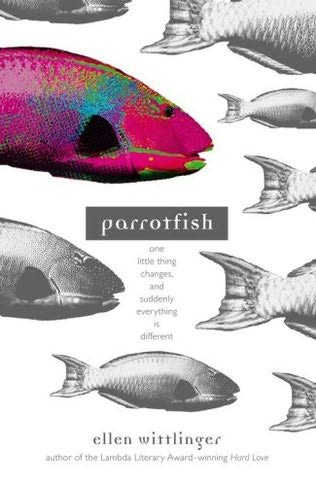
Parrotfish by Ellen Wittlinger

Wittlinger, Ellen. Parrotfish. Simon and Schuster, 2007. 304 pages. ISBN-10: 1416916229. ISBN-13: 978-1416916222.

Plot:
Angela has never really felt like a girl. At the age of 16, she decides instead to start living as a boy. She cuts her hair short, binds her breasts, starts dressing in boys clothes, and asks that everyone refer to her as Grady from now on. Grady’s family has a hard time accepting this, especially his mother and sister. His best friend, Eve, even drops him as a friend, deeply hurting Grady in the process. Acceptance isn’t quick to come in school either. Many of the teachers and the principal refuse to acknowledge his new identity and some of the students start to bully him. Eve’s new friends make Grady the target of some very cruel jokes. Even those who are more accepting of his change don’t fully understand how hurtful their ignorant and supposedly innocent comments and actions are, such as when two members of the basketball team decide to dress up as girls for a laugh. As Grady struggles with acceptance, he questions why it is so important what gender a person is.

Luckily, Grady has the help of his new friend Sebastian and the female gym coach. Both accept Grady for who he is without any reservation and do whatever they can to help him. He also falls in love for the first time with a beautiful and kind girl named Kita. With the support of his new friends, he gains the courage to deal with those who are against his transformation. In becoming who he really is, he also helps those around him begin to find out who they really are.

Critical Evaluation:
With Parrotfish, Wittlinger has made an important contribution not only to GLBT literature, but young adult literature in general. In young adult literature, there is a lack of books focusing on transgendered teens. Those that do often present it in either a joking manner or involve tragedy. Parrotfish does neither. There is humor and there are hardships, but it’s a serious and uplifting story over all. It’s not a story that is strictly about a transgendered character dealing with the change, however. It’s also about a teenager’s first love and friendship and dealing with family difficulties. These are all things to which any teenager can relate, not just those who are questioning their gender or their identity. By rounding out the story this way, Grady isn’t just a flat symbol to further a message, but an interesting and full person.

Wittlinger’s simple writing style and honest voice are a great vehicle for Grady’s story. The book moves along quickly, keeping the reader engaged. The first-person perspective personalizes the story, so that the reader becomes a part of it instead of looking in from the outside. The use of the imaginary dialogue was a humorous touch and really gives insight into Grady’s character. This book is a great read for those who are questioning their identity or want more insight into people who do. It’s also a great read for anyone looking for a good story to enjoy.

Reader's Annotation:
Transgendered high school junior Angela decides to start living as a boy named Grady. His transformation isn't easy, but he learns who he is and who his true friends and family are.

Author Information:
Ellen Wittlinger was born in Belleville, Illinois on October 21, 1948. As a child, her parents owned a grocery store that was joined to their house and she would often raid the ice-cream and candy shelves. She attended college at Millikin University and then moved to Ashland, Oregon. She stayed there until being accepted to the Iowa Writer's Workshop at the University of Iowa with the intention of becoming a poet. After that, she moved to Provincetown, Massachusetts for a fellowship at the Fine Arts Work Center.

She published a book of poetry and several plays. She first became interested in young adult literature after working as a children’s librarian and having children of her own. She published her first novel in 1993 and has written 12 more novels for young adults, with the last one published in 2008.

Genre:
Realistic Fiction: Gender Identity

Curriculum Ties:
Psychology: Gender Dysphoria
Sociology: Family Dynamic

Booktalking Ideas:
  • Discuss why Grady's family and friends have such a hard time with his change
  • Talk about figuring out who you really are, even if it means being different than everyone else
  • Discuss what it means to be transgendered.

Reading Level/Interest Age:
14 and older

Challenge Issues:
Transgendered protagonist

Challenge Defense Ideas:
  • Require the challenger to fill out a written challenge form with clear reasons stated and examples given.
  • If not already familiar with the content, become familiar.
  • Refer the challenger to the library's collection policy.
  • Refer the challenger to reputable reviews of the books, as well as reviews by those in the book's target audience.

Reasons for Selection:
This is a wonderful book for teens questioning their gender or anyone who would life to better understand those who do.

Sunday, October 31, 2010

Speak (Movie)

Speak. Showtime Independent Films, 2004.
Cast: Kristen Stewart, Michael Angarano, Robert John Burke, Hallee Hirsh, Eric Lively.
Director: Jessica Sharzer.
Writer: Laurie Halse Anderson (Novel), Jessica Sharzer (Screenplay)
Rating: PG-13.
Length: 93 minutes.
ASIN: B000A7Q2I2

Plot:
Melinda Sordino begins her freshman year of high school as an outcast. Over the summer, she attended a party where she was raped by Andy Evans, a senior. Scared and hurt, she called 911 and when the police came, everyone blamed her for trying to bust the party. Even her friends won’t talk to her and worse, her best friend Rachel begins dating Andy. Traumatized from the rape and unable to talk to anyone about it, Melinda slowly begins to lose the will to speak at all. She is a clever and witty girl, but her comments are only heard through her thought voice-overs. Her inability to speak isn’t helped by her weird teachers, especially the coach who bullies her. The only people who are able to get through to her are her art teacher, Mr. Freeman, and her lab partner, Dave Petrakis. Mr. Freeman encourages Melinda to express herself through art and she finds that she really enjoys doing so. She begins to decorate an unused storage closet that she finds and it becomes her escape when school is too much to handle. Melinda finally gains the courage to tell Rachel what happened. Rachel doesn’t believe her, but eventually confronts Andy about it causing Andy to come after Melinda. With the help of the people who do believe in her, Melinda must learn to speak again and stand up for herself.

Critical Evaluation:
Speak is a fairly loyal movie adaptation of the book, but it does seem as if something is lost in the translation. Though Melinda is an endearing character in both the book and the movie, it’s impossible to include all of her wit, charm, pain, and fear in the screen version. However, Kristin Stewart does an excellent job conveying it as well as is possible. The story is sad without being overly maudlin and it does include several moments of humor. The ending is uplifting and empowering; it is an aspect of the book that was able to be adapted well for the screen.

Speak has a message that goes beyond the surface story of speaking up about a rape. It shows the difficulty and importance of gaining the courage to speak up for yourself in any situation. This is a wonderful message for teenagers in general and young girls specifically. The book has proven to have a large positive impact on its readers and the move is sure to do the same.

Annotation:
After a traumatic experience at a party the summer before, Melinda begins her freshman year of high school as an outcast who has stopped speaking.

Director Information:
Jessica Sharzer was born October 26, 1972 in Iowa City, Iowa. She attended Wesleyan University for her undergraduate education. She then received an M.A. from Berkeley and an M.F.A. in film from New York University.

She began her career in 1998 and has worked in almost all aspects of the film business, other than acting. She began directing short films in 2000. Speak has been her only feature length directorial project. She also wrote the screenplay for the movie.

Genre:
Movie: Drama

Curriculum Ties:
Art: Therapeutic Value of Art
Psychology: Sexual Assault Victim Mentality, Rape Recovery
Health/Sex Ed: Healthy Relationships, Healthy Sexual Contact

Movie Talking Ideas:
  • Present as Melinda talking about losing her ability to speak.
  • Focus on the opening scene of the movie.
  • Focus on the rape survivor aspect and speaking up.

Interest Age:
13 and older

Challenge Issues:
Rape
Inappropriate language

Challenge Defense Ideas:
  • Require the challenger to fill out a written challenge form with clear reasons stated and examples given.
  • If not already familiar with the content, become familiar.
  • Refer the challenger to the library's collection policy.
  • Refer the challenger to reputable reviews of the books, as well as reviews by those in the book's target audience.

Reasons for Selection:
I've read the book, but I was unaware there was a movie until hearing about the challenge against it in Republic, MO. I decided I wanted to see if the movie was a fair representation of the book.

Shadowland (The Mediator #1) by Meg Cabot

Cabot, Meg. Shadowland. Simon Pulse, 2000. 256 pages. ISBN-10: 0671787918. ISBN-13: 978-0671787912.

Plot:
Suze Simon has always been able to see, talk to, and touch ghosts. She's a mediator and it's her job to help ghosts pass over into the after life, though some ghosts don’t need help so much as a kick in the butt to get them going. When Suze moves from New York to California to live with her new step-family, she hopes that she can put her job behind her and live like a normal girl. Unfortunately, she discovers that her room is haunted by a very cute ghost named Jesse and he seems pretty content to stick around. Suze also learns that there is the ghost of a girl named Heather hanging around her school. Heather shot herself after her boyfriend broke up with her and she is out for revenge. With the help of Jesse and Father Dominic, another mediator, Suze must try to help Heather cross over. Heather isn’t interested; she thinks that Suze is there to take her place. Heather wants her old life back and she isn’t going to let anyone stand in her way, no matter who gets hurt.

Critical Evaluation:
Like most of Cabot’s writing, this is a very cute book. Suze is a hilarious narrator. Her comments about those around her and her transition to life in California are humorous and witty. Though she tries to maintain a tough persona, her sensitivity often shines through. This aspect of her personality makes her a very sympathetic character. Jesse is an unusual but great romantic hero. His old fashioned chivalry perfectly counters Suze’s modern tough girl. Their budding romance is the driving force of the book.

The romance isn’t the only fun aspect, however. The mediator storyline is entertaining, especially when it comes to the disparity between Suze’s methods and Father Dominic’s methods. The two of them bouncing off of each other is one of the more fun parts of the story. Though Cabot does insert a few small frightening parts when it comes to the mediating, they don’t seem out of place with the relatively light storyline. This is definitely a fun read.

Reader's Annotation:
Suze is a mediator, which means she has an unusual gift: she can see, touch, and talk to ghosts. When she encounters a cute ghost who lives in her new bedroom, her life becomes even more complicated than it already was.

Author Information:
Meg Cabot was born on February 1, 1967 in Bloomington, Indiana. As a child, she was an avid reader and frequently spent her summer days in the library. In high school, she entertained herself by writing her own stories. She credits much of her inspiration for writing from the diaries she kept as a teenager, her own experiences, those of people she knows, and things she reads in the news, as well as a healthy dose of imagination.

She attended the University of Indiana as a Fine Arts major. After college, she moved to New York to pursue a career as an illustrator. When that failed, she turned again to writing. Her first novel - Where Roses Grow Wild - was published in 1998 under the pen name Patricia Cabot. Since then she has published over 40 novels for young adults as well as several others for tweens and adults. She has published under the pen names of Patricia Cabot, Jenny Carroll and under her real name.

Genre:
Fantasy

Curriculum Ties:
None

Booktalking Ideas:
  • Talk about what it would be like to be a mediator.
  • Discuss Suze's relationship with Jesse.
  • Introduce Suze in character.

Reading Level/Interest Age:
13 and older

Challenge Issues:
Violence

Challenge Defense Ideas:
  • Require the challenger to fill out a written challenge form with clear reasons stated and examples given.
  • If not already familiar with the content, become familiar.
  • Refer the challenger to the library's collection policy.
  • Refer the challenger to reputable reviews of the books, as well as reviews by those in the book's target audience.

Reasons for Selection:
Meg Cabot's books have been popular with teens for many years.

Saturday, October 30, 2010

Girl, 15, Charming but Insane by Sue Limb

Limb, Sue. Girl, 15, Charming but Insane. Delacorte Books for Young Readers, 2004. 224 pages. ISBN-10: 0385732147. ISBN-13: 978-0385732147.

Plot:
Jess Jordon is a typical 15-year-old girl who believes that her life is a disaster. Her best friend, Flora, is beautiful, smart, and comes from a perfect family. Jess, by contrast, has a body she dislikes, an absent father, and the tendency to let her mind wander while in class. She also has a crush on popular boy, Brad. After Flora starts dating Brad’s best friend and the three of them start a band, Jess has a chance to get to know Brad. All he wants to do it talk about Flora. In her quest to get to know Brad, Jess looks past her other best friend, Fred. Fred is the one who has always been there for her, from stealing an embarrassing topless video of her that surfaced after a party to letting her stay with him after she and her mother had a blow out. Consumed with her obsession with Brad and her rivalry with Flora, Jess doesn’t fully appreciate Fred until it is too late. After accidentally blowing off his mother’s birthday party because of a family emergency, Jess finds that Fred is no longer speaking to her. As she attempts to fix this situation, Flora reveals to Jess that she likes Fred, which makes Jess jealous. Jess must make up with Fred, figure out her situation with Brad, and deal with Flora, all the while dealing with all the other problems that come with being 15.

Critical Evaluation:
Jess is an incredibly funny narrator. She has a wit and self-deprecating humor that is charming to all audiences, but will especially appeal to teen readers. She’s a very realistic character who has a tendency to make mistakes and end up in embarrassing situations. The reader can both cringe and sympathize when reading about her latest problem. The other characters aren’t quite as well-developed as Jess, but instead read as reflections of her views of them, rather than actual people. This serves well to further Jess’s characterization, however.

The writing is simple and in a style appropriate to the teenage narrator. It isn’t overly flowery, but the author does allow some whimsy appropriate to Jess’s overactive imagination. The plot isn’t complicated or involved but instead just focuses on average events that could easily occur in the life any teenage girl. This isn’t a book that will teach a moral or that is very thought-provoking; it is entertaining. If the reader is in the mood for a cute, light, funny read this is an excellent choice.

Reader's Annotation:
15-year-old Jess has enough to deal with between her too perfect best friend Flora, her absent father and his “horrorscopes,” giving up her room to her death-obsessed grandma, a falling out with her other best friend, Fred, and her undying love for Brad. When Flora starts dating Brad’s best friend, Jess decides now is the time to get Brad to notice her, but is he really the one for her?

Author Information:
Sue Limb was born in Hitchin, Hertfordshire, England in 1946. She attended Cambridge to study English, Elizabethan Poetry, and get her certification in Education. Prior to becoming an author, she spent a decade working on and off as a teacher. She taught Literary Criticism at the college lever and both English and Drama at the secondary level. She also spent a year teaching in a prison. She then spent several years working in radio and television, including adapting her novel Up the Garden Path for both a BBC radio and later ITV as a sitcom. However, what is probably her most well-known work was that of her column in The Guardian written under the pen-name of Dulcie Domum. From 1990-2001, she wrote a humorous column entitled "Bad Housekeeping" about a feminist novelist’s experiences as a rural wife.

Besides writing, she lists several interests on her website including horticulture, agriculture, music, politics, painting, natural history, architecture, and travel. These interests are evident in much of her non-young adult work. She has written close to 30 books for adults and teens. Her writing has won several awards including Book Sense Picks and the School Library Journal award.

Genre:
Chick Lit

Curriculum Ties:
None

Booktalking Ideas:
  • Present part of Jess's personals ad monologue.
  • Present as Jess talking about her many problems and her love for Brad.

Reading Level/Interest Age:
14 and older

Challenge Issues:
Profanity
Sexual content
Inappropriate language

Challenge Defense Ideas:
  • Require the challenger to fill out a written challenge form with clear reasons stated and examples given.
  • If not already familiar with the content, become familiar.
  • Refer the challenger to the library's collection policy.
  • Refer the challenger to reputable reviews of the books, as well as reviews by those in the book's target audience.

Reasons for Selection:
It was one of the books I read for our chick lit presentation and I enjoyed it enough to include it here.